
Train at the Only Fellowship Distinguished in All 3 Domains
Tampa General Hospital (TGH) and USF Health offer the only Fellowship Council-accredited surgical fellowship in bariatric, foregut and abdominal wall/hernia surgery all three, under one program. Two fellowship positions open annually. This is where your subspecialty career begins.
This fellowship operates at the intersection of Tampa General Hospital and USF Health, Florida's premier academic health system. USF Health Morsani College of Medicine holds a Tier 1 research designation, one of only 16 medical schools in the nation to earn that distinction, and ranks No. 1 among Florida medical schools for research funding. Tampa General Hospital performs more than 48,000 surgeries annually and supports more than 13,500 endoscopies per year. Fellows train within a system where clinical volume, academic mission and research infrastructure reinforce each other at every stage.
A Program Built on National Distinction
Most fellowships specialize in one domain. This program leads in three. Backed by one of the busiest academic surgical platforms in Florida, fellows train at a program that has earned recognition most programs never reach.
- Nationally ranked institution: Tampa General Hospital ranks among the Top 20 programs in the nation for Gastroenterology and GI Surgery by U.S. News & World Report for 2026-27.
- Hernia Center of Excellence: One of only five national sites selected for inaugural accreditation by the American Hernia Society
- Longest-standing bariatric accreditation in Florida: Six consecutive MBSAQIP accreditations
- One of the largest foregut and esophageal robotic surgery programs in the nation
- One of the largest esophageal motility programs in the southeastern U.S.
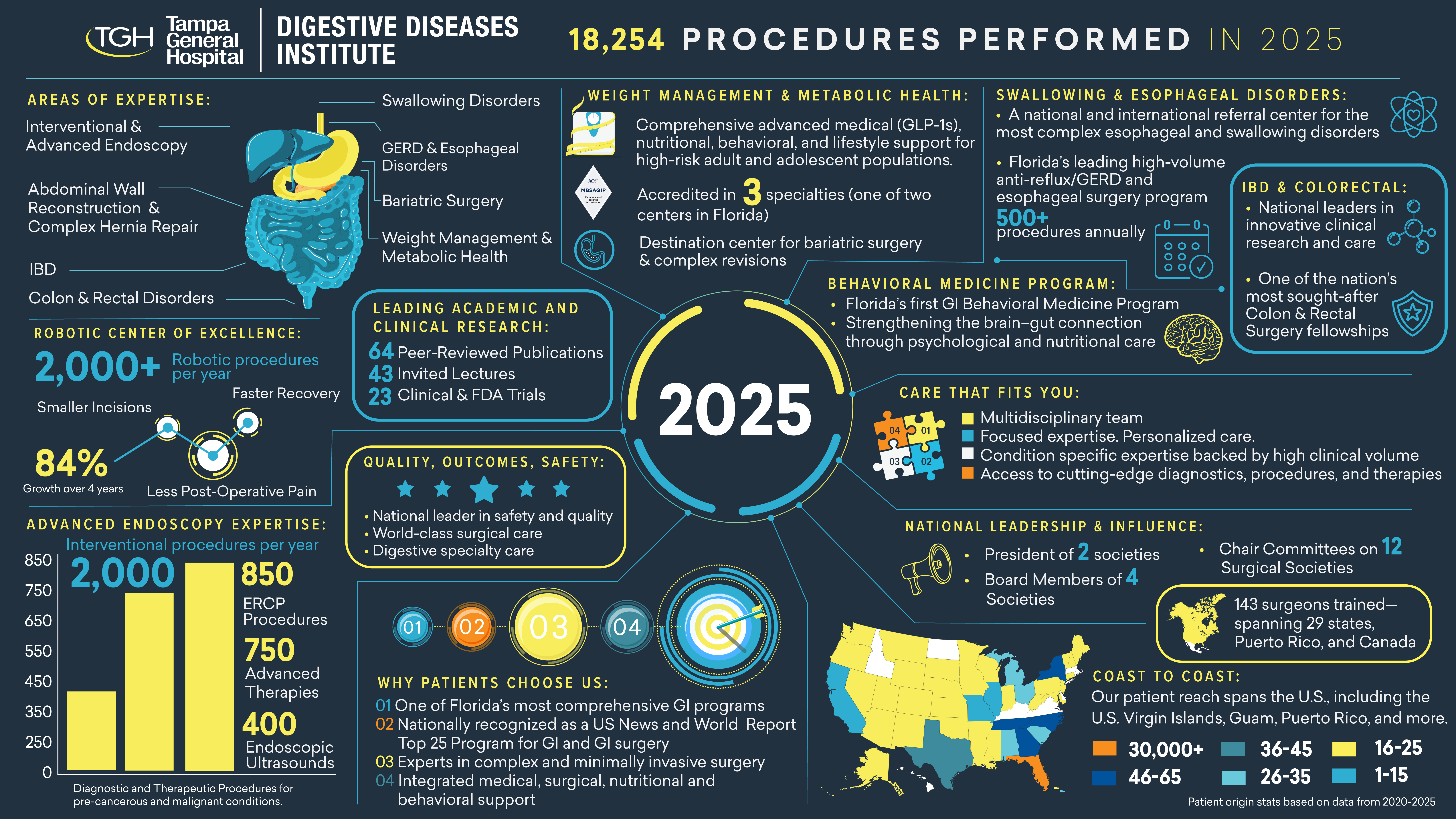
- One of the busiest academic robotic surgery programs in Florida: 2,111 robotic cases performed in fiscal year 2025
Surgical Training at Scale
Volume drives mastery. At Tampa General Hospital, fellows train across a high-volume surgical environment that few programs in the country can match.
Bariatric and Metabolic Surgery: Performing more than 280 bariatric procedures annually, including more than 65 revision surgeries. Training spans primary and complex revisional cases, with full participation in MBSAQIP quality improvement initiatives.
Foregut and Esophageal Surgery: With 397 foregut cases in fiscal year 2025, this program ranks among the largest esophageal and foregut robotic surgery programs nationally. Fellows gain direct exposure to advanced anti-reflux procedures, paraoesophageal hernia repair, esophageal resection and achalasia management.
Abdominal Wall and Reconstruction and Hernia Surgery: A nationally recognized leader in abdominal wall reconstruction, delivering world-class, patient-centered care through advanced minimally invasive and robotic techniques, multidisciplinary collaboration, and evidence-based treatment. As a high-volume academic referral center, it is dedicated not only to achieving exceptional patient outcomes but also to advancing the field of hernia surgery through innovative research, surgeon education, and the development of new standards in quality and excellence.
Where Innovation Meets Clinical Excellence
This program trains you at the forefront of surgical practice, not on the periphery of it.
Tampa General Hospital performed 2,111 robotic cases in fiscal year 2025, making it one of the busiest academic robotic programs in Florida. Fellows gain hands-on experience with the full spectrum of minimally invasive and advanced surgical techniques:
- Laparoscopic surgery
- Robotic surgery
- Open and re-operative surgery
- Diagnostic and therapeutic bariatric endoscopy
- Esophageal motility evaluation, including manometry, pH testing and radiographic swallow studies
Research is tailored to your individual career goals. Fellows pursue projects aligned with their interests and present findings at national meetings, building a scholarly profile before graduation. The DDI academic team produced 116 abstracts accepted at 11 national meetings and trained 130 surgeons from 29 states, Puerto Rico and Canada in advanced specialty procedures.
Learn more about The Digestive Diseases Institute
What This Fellowship Provides
Bariatric and Metabolic Surgery: Primary and revisional cases, metabolic outcomes, patient selection and perioperative management within an MBSAQIP-accredited program. Near-complete gastric bypass case assignment supports progressive autonomy from early in training.
Advanced Foregut and Esophageal Surgery: Anti-reflux surgery, esophageal motility disorders, paraesophageal hernia repair, esophageal resection and reconstruction, supported by one of the largest motility programs in the southeastern U.S.
Abdominal Wall Reconstruction: Component separation, biologic and synthetic mesh techniques, robotic abdominal wall reconstruction and complex re-operative cases at a nationally accredited Hernia Center of Excellence.
Diagnostic and Therapeutic Endoscopy: Bariatric endoscopy, upper endoscopy and endoscopic evaluation, including per-oral endoscopic myotomy (POEM), integrated throughout the surgical curriculum.
Esophageal Motility Program: A structured, high-volume motility program offering hands-on training in manometry, ambulatory pH and impedance testing, functional lumen imaging probe and radiographic swallow studies.
Scholarship Activities: Fellows participate in a dedicated bariatric and foregut meeting with a predetermined curriculum as part of their scholarly activities, reinforcing clinical learning with structured academic development.
What Makes this Fellowship Different
- Progressive Autonomy: You advance through a structured, graduated model of operative responsibility. By program's end, you are prepared to operate independently and lead your own surgical team. Near-complete gastric bypass case assignment is a hallmark of this model.
- Teaching Responsibilities: Fellows participate directly in the education of medical students and residents, building the teaching skills that define academic surgical careers. You supervise all patients on the service and staff residents on select general surgery procedures.
- Resident Collaboration: The fellowship integrates you into the academic training environment. Night call is covered by the resident night float team, ensuring your focus remains on high-quality subspecialty training.
- Call Structure: This program operates on a home call model. Fellows are not assigned in-house overnight call, preserving the quality of training and supporting sustainable professional development.
- Tailored Research: Research is built around your career goals, not a predetermined agenda. Fellows present findings at national meetings and graduate with a scholarly foundation suited to academic or high-volume private practice.
Meet the Faculty
This fellowship is led by a world-class, collaborative and high-performing faculty team within the TGH Digestive Diseases Institute. Our faculty bring national recognition, subspecialty depth and a genuine commitment to fellow development.
[Download the Physician Directory]
Who We Are Looking For
We seek candidates committed to subspecialty surgical excellence, who approach complex cases with discipline and curiosity, and who want to contribute to a program that advances the field.
If you are preparing for a career in academic or high-volume private practice in bariatric, foregut or hernia surgery, this fellowship was built for you. Two positions are available each year. We accept the most motivated, qualified candidates, full stop.
Take the Next Step in Your Surgical Career
Apply today or contact our fellowship coordinator to learn more about the application process, program timeline and selection criteria.
Frequently Asked Questions
Tampa offers the best of both worlds: the resources and complexity of a nationally recognized academic health system combined with an exceptional quality of life. Enjoy year-round sunshine, waterfront living, short commutes, professional sports, renowned restaurants, and easy access to award-winning Gulf Coast beaches all while training at one of the nation's leading academic healthcare partnerships between Tampa General Hospital and USF Health.
Upon successful completion of the fellowship, graduates receive training and recognition that distinguishes them as highly qualified surgeons in bariatric, foregut, hernia, and abdominal wall surgery. Fellows graduate with:
- Fellow of the American Society for Metabolic and Bariatric Surgery (FASMBS) pathway eligibility through comprehensive bariatric and metabolic surgery training.
- Foregut Surgery Fellowship completion, recognized through educational pathways supported by leading societies including the Society of American Gastrointestinal and Endoscopic Surgeons (SAGES), the Society for Surgery of the Alimentary Tract (SSAT), and the American Foregut Society (AFS).
- Advanced Robotic Surgery Training, with extensive hands-on experience performing complex robotic bariatric, foregut, and abdominal wall procedures.
- Advanced Endoscopy Training, including diagnostic and therapeutic bariatric endoscopy, esophageal motility testing, pH monitoring, and other foregut-focused endoscopic procedures.
Beyond these credentials, graduates leave the program with the operative experience, clinical judgment, and progressive autonomy necessary to independently practice bariatric, foregut, hernia, and abdominal wall surgery.
Fellows train within a world-class academic healthcare environment that combines high-volume clinical experience with cutting-edge surgical education.
Tampa General Hospital (TGH) serves as the fellowship's primary clinical training site. As one of the nation's leading academic health systems and the primary teaching hospital of the USF Health Morsani College of Medicine, TGH provides fellows with extensive exposure to complex bariatric, foregut, hernia, and abdominal wall cases across a diverse patient population.
Fellows also train at the Center for Advanced Medical Learning and Simulation (CAMLS), one of the largest and most advanced simulation centers in the United States. CAMLS features a virtual operating room, animate labs, robotic surgery training platforms, and state-of-the-art procedural training facilities that allow fellows to refine technical skills in a highly realistic environment.
In addition, fellows spend significant time within the TGH & USF Weight Management & Metabolic Health Center, a comprehensive, multidisciplinary facility dedicated to metabolic surgery and weight management. This integrated center brings together surgeons, obesity medicine specialists, dietitians, psychologists, advanced practice providers, and researchers in a collaborative setting designed to deliver exceptional patient care while enhancing fellow education. Fellows gain valuable experience in outpatient management, program development, interdisciplinary collaboration, and clinical research.
Beyond operative training, our fellowship is designed to prepare graduates for leadership roles. Fellows learn how to develop and grow comprehensive bariatric and minimally invasive surgery programs while gaining experience in quality improvement, program administration, business development, multidisciplinary communication, and team leadership.
By graduation, fellows are equipped not only with advanced surgical skills, but also with the knowledge and experience required to build and lead successful bariatric, foregut, and abdominal wall surgery programs.
The fellowship is affiliated with the USF Health Morsani College of Medicine, one of the nation's premier academic medical institutions and the academic partner of Tampa General Hospital. USF Health is recognized for its commitment to innovation, research, surgical education, and patient-centered care, providing fellows with access to a robust academic environment and extensive multidisciplinary collaboration.
The fellowship is housed within the Division of Gastrointestinal and General Surgery, a nationally recognized program that serves as a referral center for complex bariatric, foregut, esophageal, abdominal wall, and hernia disease. The division is composed of nationally and internationally respected surgeons who are leaders in minimally invasive, robotic, and advanced endoscopic surgery and who actively contribute to research, education, and the advancement of gastrointestinal surgical care.
As part of this academic environment, fellows work closely with faculty, residents, medical students, advanced practice providers, and multidisciplinary specialists while participating in cutting-edge clinical care, research, quality improvement, and surgical innovation. This comprehensive experience prepares graduates not only to become exceptional surgeons but also future leaders in academic and community practice.
Christopher DuCoin, MD, MPH, FACS, FSAGES, FASMBS serves as the Fellowship Director for the Bariatric, Foregut, Hernia, and Abdominal Wall Fellowship at the University of South Florida and Tampa General Hospital.
Dr. DuCoin is a board-certified general surgeon, Professor of Surgery at the University of South Florida, Vice Chair of Surgery, and Chief of the Division of Gastrointestinal & General Surgery. He also serves as Chief of the Tampa General Hospital Digestive Diseases Institute, Director of the TGH Robotics Program, and Director of the GERD & Esophageal Program.
Nationally and internationally recognized for his expertise in foregut surgery, bariatric surgery, advanced endoscopy, and robotic surgery, Dr. DuCoin has dedicated his career to advancing the treatment of complex gastrointestinal diseases, particularly GERD, esophageal disorders, obesity, and their relationship to esophageal cancer. He is widely regarded as one of the country's leading educators in minimally invasive and robotic surgery, having trained more than 60 surgical residents and numerous fellows throughout his career.
Dr. DuCoin holds leadership positions in many of the field's most influential organizations. He serves on the Board of the Society of American Gastrointestinal and Endoscopic Surgeons (SAGES), chairs its Research Committee, is a leader within the American College of Surgeons (ACS), and serves as President of the Florida Chapter of the American Society for Metabolic and Bariatric Surgery (ASMBS). His academic contributions include more than 100 peer-reviewed publications, presentations, and research initiatives that continue to shape the future of gastrointestinal surgery.
Before joining USF and Tampa General Hospital, Dr. DuCoin served as Division Chief at Tulane University Medical Center, where he developed innovative bariatric surgery programs that expanded access to underserved patient populations and gained national recognition. Throughout his career, he has remained committed to clinical excellence, surgical education, innovation, and compassionate patient care.
As Fellowship Director, Dr. DuCoin is passionate about developing technically excellent, thoughtful surgeons who are prepared to become leaders in bariatric, foregut, abdominal wall, and minimally invasive surgery. His philosophy is simple: "Treat every patient as if they were your family." This patient-centered approach, combined with a commitment to progressive autonomy and mentorship, helps ensure fellows graduate prepared for successful and impactful careers.
Salvatore Docimo, Jr., DO, MBA, FACS, FASMBS serves as the Associate Fellowship Director for the Bariatric, Foregut, Hernia, and Abdominal Wall Fellowship at the University of South Florida and Tampa General Hospital.
Dr. Docimo is a fellowship-trained, board-certified general surgeon and Associate Professor of Surgery at the USF Health Morsani College of Medicine. His clinical expertise includes bariatric surgery, complex abdominal wall reconstruction, hernia repair, advanced therapeutic endoscopy, and minimally invasive and robotic surgery. He is dedicated to helping patients achieve lasting health outcomes while minimizing recovery time through innovative surgical techniques and state-of-the-art technology.
After earning his Doctor of Osteopathic Medicine degree from the New York College of Osteopathic Medicine, Dr. Docimo completed his general surgery residency at NYU Langone Hospital–Brooklyn and a fellowship in minimally invasive surgery at Penn State Hershey Medical Center. Prior to joining USF Health, he served on the faculty at Stony Brook Medicine, where he directed the Gastroparesis Center and co-directed the Center for Abdominal Core Health and Complex Hernia Repair.
At USF Health and Tampa General Hospital, Dr. Docimo has played a key role in building and expanding the program's advanced bariatric and therapeutic endoscopy services. He is recognized for his expertise in abdominal wall reconstruction and was instrumental in developing the endoscopic bariatric program within the TGH-USF Health Bariatric Center.
An accomplished academic surgeon, Dr. Docimo has authored more than 70 peer-reviewed publications and serves as co-editor of Clinical Algorithms in General Surgery: A Practical Guide. He is an active leader in several national surgical organizations, including the American Society for Metabolic and Bariatric Surgery (ASMBS), the Society of American Gastrointestinal and Endoscopic Surgeons (SAGES), and the Americas Hernia Society (AHS), where he currently serves as Co-Chair of the Education Committee.
As Associate Fellowship Director, Dr. Docimo is passionate about surgical education and mentorship. Fellows benefit from his expertise in bariatric surgery, complex hernia repair, abdominal wall reconstruction, therapeutic endoscopy, and robotic surgery while gaining hands-on experience in managing some of the most challenging gastrointestinal surgical conditions.
The USF Health/Tampa General Hospital Bariatric, Foregut, Hernia, and Abdominal Wall Fellowship has a long history of leadership in advanced gastrointestinal surgical education and has consistently been at the forefront of fellowship training nationally.
Our program was among the earliest accredited bariatric surgery fellowships in the country, with more than two decades of experience training future leaders in metabolic and bariatric surgery. Recognizing the evolving needs of modern gastrointestinal surgeons, the fellowship expanded approximately eight years ago to include comprehensive foregut surgery training, becoming one of the first programs to offer a truly integrated bariatric and foregut experience.
Today, the program continues to evolve with the addition of abdominal wall reconstruction and complex hernia surgery, creating a unique training model that reflects the realities of contemporary practice. As a result, fellows receive comprehensive exposure across all three disciplines—bariatric surgery, foregut surgery, and abdominal wall/hernia surgery within a single fellowship experience.
As a Fellowship Council-accredited program, the fellowship is distinguished by its high operative volume, multidisciplinary approach, nationally recognized faculty, and commitment to innovation, research, and surgical education. This comprehensive training prepares graduates to independently build and lead advanced bariatric, foregut, and abdominal wall surgery programs in both academic and community settings.
As one of the nation's leading digestive health programs, the Tampa General Hospital Digestive Diseases Institute (DDI) cares for patients with the full spectrum of gastrointestinal disorders from common digestive conditions to some of the most complex surgical referrals in the Southeast.
The most common conditions and clinical programs fellows encounter include:
- Obesity and metabolic disease, including primary and revisional bariatric surgery. DDI performs more than 500 bariatric procedures annually and is one of Florida's highest-volume academic bariatric programs.
- GERD and foregut disorders, including hiatal hernias, paraesophageal hernias, reflux disease, dysphagia, esophageal motility disorders, Barrett's esophagus, and esophageal cancer.
- Complex abdominal wall and hernia disease, including primary, recurrent, and complex ventral hernias, abdominal wall reconstruction, and hernias in patients with obesity.
- Advanced endoscopic conditions, including bariatric endoscopy, gastroparesis, POEM/G-POEM procedures, and management of surgical complications.
- Neurogastroenterology and motility disorders, including swallowing disorders and gastroparesis. DDI is home to one of the few dedicated swallowing and motility programs in the region.
- Inflammatory bowel disease (IBD), including Crohn's disease and ulcerative colitis.
- Colorectal disease and GI cancers, with nationally recognized expertise in colorectal surgery and gastrointestinal oncology.