
A Complex Swallowing Challenge Is Met With Patient-Centered Treatment
Published: Apr 1, 2026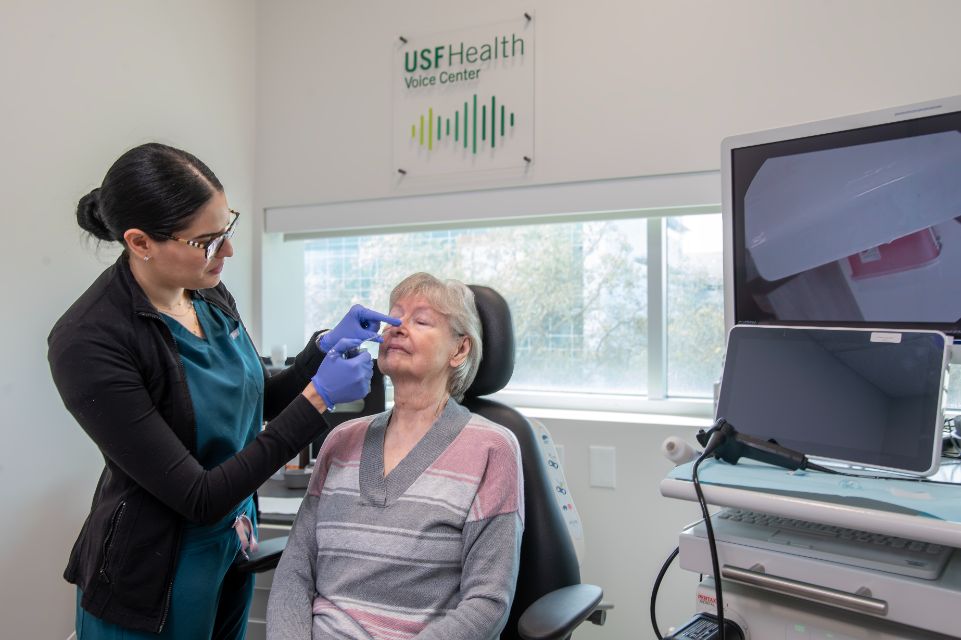
Restoring Swallowing and Quality of Life After Head and Neck Cancer.
When Jennie Watkins imagined retirement, she pictured time with her grandchildren, shared meals with family and the freedom to travel. Instead, after treatment for tonsil cancer, she faced the prospect of a devastating and uncommon complication. Her esophagus completely closed, leaving her unable to swallow — and dependent on a feeding tube for nearly two years.
“I had been through so much,” Watkins said. “I was prepared to just live with the feeding tube.”
After exhausting other options, Watkins was referred to Dr. Yassmeen Abdel‑Aty, an assistant professor of laryngology in the Department of Otolaryngology and Head and Neck Surgery at the USF Health Voice Center, who also performs surgery at Tampa General Hospital. Her case required a highly specialized approach and the resources of a leading academic medical center.
Lifelong Support Throughout and Beyond Cancer Care
Watkins was diagnosed with severe post‑radiation esophageal stenosis, a complication that can occur after head and neck cancer treatment. The condition causes scarring that can narrow or close the esophagus, making swallowing extremely difficult or impossible.
Dr. Abdel‑Aty advised a multi-step approach to best treat Watkins. To start, a complex operation was performed at Tampa General that combined upper airway endoscopy, laser surgery and a novel double balloon dilation technique to reopen her esophagus.
“Tampa General provides the operating room technology and expert teams that allow us to safely treat some of the most challenging cases,” Dr. Abdel‑Aty said. “That level of support is critical for patients like Jennie.”
As the primary teaching affiliate of USF Health, Tampa General, through its Head and Neck Surgery Center of Excellence, brings together advanced surgical care, research and clinical expertise for patients with head and neck conditions.
Continuing Care Through Innovation and Partnership
Surgery was only part of Watkins’ recovery. Following her procedure at Tampa General, she began a self‑dilation program through the USF Health Voice Center, an approach designed to prevent the esophagus from narrowing again, which is a risk after head and neck radiation treatment.
This unique program allows patients to perform esophageal dilation safely at home, helping maintain the surgical results while giving patients an active role in their recovery.
“At first, I did not think I could do it,” Watkins said. “But now we have it down to a science. It takes less than 15 seconds, and it gave me my life back.”
Research led by Dr. Abdel‑Aty shows that self‑dilation can improve swallowing function, reduce aspiration risk and help patients return to eating by mouth after head and neck cancer treatment.
A Life Renewed
Today, Watkins no longer relies on a feeding tube. She cooks with her husband, goes out to eat and enjoys everyday moments that once felt out of reach.
“I missed cooking. I missed being social,” she said. “Now I can do those things again. I have been through the fire and come out the other side.”
Her journey reflects what is possible when expert surgical care at Tampa General is paired with thoughtful follow‑up care through USF Health. For patients facing head and neck and airway conditions, that collaboration can mean not just recovery, but a renewed quality of life.