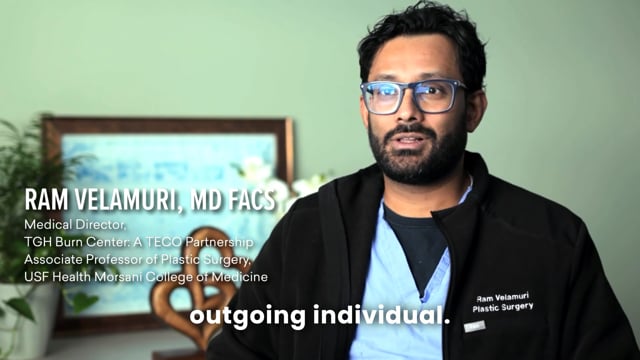
TGH Burn Center: A TECO Partnership is one of just six burn centers in Florida to have earned Verification by the American Burn Association/American College of Surgeons and one of only two ABA-verified adult and pediatric burn centers in Florida. This distinction means the regional burn center has met stringent guidelines for patient care procedures, facilities, and staffing. The center treats critically burned patients from emergency admission through rehabilitation, treating more than 500 adult burn patients and about 300 pediatric burn patients each year.
State-of-the-Art Burn Center and Burn ICU
Equipped with the latest technology, the newly renovated 18-bed specialty unit includes a 6-bed intensive care unit, a 12-bed wound care unit, treatment rooms and a burn operating room conveniently located within the unit. All rooms feature Tampa General's new "patient rooms of the future," which increase efficiency of care with advanced technologies and allow caregivers to quickly receive the information they need to provide better patient care.
Multidisciplinary, Focused Care on the Specific Needs of Burn Patients
TGH Burn Center's nurses and physicians are highly trained in the care of patients who have experienced a burn trauma from fire, chemicals, oil or electricity over more than 10% of their body. All nurses within the unit have Advanced Burn Life Support (ABLS) certification. Specialized care provided in Tampa General’s Burn ICU includes intravenous fluid replacement, breathing support, pain control and treatment of burn wounds. The ICU is equipped with state-of-the-art monitoring equipment.
Within the updated center, care is truly multidisciplinary and focused on the specific needs of the burn patient. Physicians, advanced practice providers, nurses, and therapists provide expertise in infection prevention, nutrition, wound care, reconstruction and rehabilitation. Tampa General also has a Burn Survivor program for patients that provides support after their initial injury.
Outpatient Burn Clinic
Following discharge from TGH Burn Center, patients are scheduled for follow-up appointments at the Outpatient Burn Clinic, located in the TGH Specialty Center at Harbourside Medical Tower. These periodic visits allow our health care professionals to closely monitor each patient’s healing process.
During the clinic visit, the physician or Advanced Nurse Practitioner examines the patient and makes recommendations concerning medication adjustment, bandage changes, physical activity level, and return to work or school. The clinical teams assist the patient and family with any questions or concerns regarding wound care. This assistance includes offering advice about discomfort, itching, and your home care routine.
To make an appointment with the Outpatient Burn Clinic, please call and leave a message with your name and contact information. You can expect a return call within 24-48 hours, please allow more time if calling over the weekend. Referrals are accepted for Burn Care, Reconstructive Burn, CO2 Laser Treatment, ER and hospital follow up.
Appointments are required to ensure you receive timely, personalized care without unnecessary waiting. We do not accept walk-ins.
- Phone: (813) 844-7656
- Location: Harbourside Medical Tower - 5 Tampa General Circle, Suite 440, Tampa, FL 33606
- Days: Mondays, Tuesdays, and Thursdays
Many patients and families find it helpful to write down their questions or concerns to bring to the clinic visit. Patients who anticipate a dressing change during a visit should take over the counter or previously prescribed pain medication 30 minutes prior to their appointment.
Parking Information
For a flat, $3 fee, visitors can park in the parking garage located on the TGH Davis Islands campus and there is off-site parking for free.
If you would like to receive more information about how to get to TGH Burn Center, please call our general number at (813) 844-7656.
Burn Treatment at TGH
A minor, first-degree burn may only require simple at-home treatment, but burns that are severe or are located in sensitive areas of the body typically require specialized treatment at a burn center. Tampa General Hospital is one of about 70 hospitals in the country to have earned burn center verification by the American Burn Association in conjunction with the American College of Surgeons. This mark of distinction means that TGH meets strict guidelines regarding our facilities, patient care, procedures performed, and staff members. Additionally, our surgeons make it a priority to stay up-to-date on and test the latest treatments for burn patients, ensuring that our adult and pediatric patients receive the most comprehensive and advanced care possible.
Treatment of a burn injury at TGH begins by cleaning the skin and applying medicine and dressings over the burn(s). After the medical evaluation, cleaning, and dressing of the wounds is completed, the patient is moved to a room. The medical team’s immediate concern is controlling physical dangers, starting intravenous (IV) lines to replace lost fluids, and actual wound care. Burn patients require special treatment to replace bodily fluids and are very susceptible to infections. Additional care is needed to prevent the permanent scarring, deformity, and dysfunction that severe burn injuries can cause. The staff at TGH will do everything it can to make the patient as comfortable as possible throughout the treatment process.
All burn patients are cared for by a highly trained staff that includes physicians, nurse practitioners, nurses, physical and occupational therapists, respiratory therapists, social workers, psychologists, and recreational therapists specializing in burn treatment and recovery. In addition, patient representatives, dietitians, child life specialists, and chaplains are available to assist patients and their families. Integrative medicine services are also available.
Some of the treatments burn patients at TGH receive include:
Replacement Fluids
Skin allows us to be weatherproof while at the same time keeping our own bodily fluids inside. When the skin is burned, bodily fluids seep out. These lost fluids must be replaced. With large burns, the fluids are replaced with an IV. The IV machine feeds the replacement fluids into the body in carefully controlled amounts. For smaller burns, fluids may be replaced by drinking.
Edema Treatment
Edema is swelling. Swelling may occur just around the burned area or it may be systemic, meaning over the entire body. The larger the burn, the greater the swelling will be. Chances are that the first time you see your loved one after they have been burned, swelling will be present. The swelling can distort features to the point that you may no longer recognize them. This swelling should begin to lessen after a few days.
Breathing Assistance
It may be necessary to assist the patient’s breathing. This may be done with a simple mask supplying oxygen or through a tube. Intubation is the insertion of a tube through the patient’s mouth or nose, directly into the windpipe. The patient can breathe through this tube, but will not be able to speak because the tube is below the vocal cords. If necessary, a ventilator can be attached to the tube to further assist breathing.
Nutrition Monitoring
A person who has sustained a burn requires a massive amount of calories as their body’s metabolic rate goes into overdrive. The metabolism speeds up to compensate for the burn injury and to begin the healing process. A feeding tube may be inserted through the nose into the stomach. Liquid food is fed to the stomach around the clock.
Foley Catheter Insertion
The Foley catheter is used to help patients urinate. A small rubber tube is inserted into the bladder, and a small balloon is inflated with sterile water to keep the catheter in place. The catheter drains the fluid from the bladder into a bag that hangs on the bed. The bag is monitored to determine how much urine is being produced, which helps the doctor determine if more or less fluid should be given to the patient.
X-Rays
A burn patient may get a lot of X-rays. These X-rays check the placement of the various tubes, such as the feeding tube, to make sure they are where they need to be. An intubated patient usually gets daily X-rays of their lungs to watch for signs of infection and pneumonia.
Skin Grafts
Skin grafting is a surgical procedure during which skin is moved from one area of the body to another that has sustained a burn. There are several types of skin grafts:
- Allograft: Allograft or cadaver skin is used as a temporary biological dressing over a cleansed (excised) wound. These are held in place with surgical staples.
- Autograft: Autograft is the skin taken from an unburned area of the burn patient. It is a permanent replacement. The autograft is removed with a tool called a dermatome, which actually slices an extremely thin layer of skin from the burned person’s body. This layer is .010 to .012 of an inch in thickness. The two types of autografts are sheet grafts and mesh grafts.
- Sheet graft: Sheet grafts are taken from an unburned area of the person’s body. The sheet graft contains no holes or stretching so it takes a larger donor site to cover the same amount of burned area. The advantage of sheet grafts is durability and less noticeable scarring. The disadvantage of sheet grafts is the possibility of loss due to fluid building up beneath the graft.
- Mesh graft: Mesh grafts cover more area. The skin is taken from the donor site, then perforated. These perforations allow the skin to be stretched, thereby covering more area. The other main advantage of mesh grafts is that the perforations allow drainage. The disadvantages of the mesh grafts are that they are not as durable as sheet grafts and the perforations leave more noticeable scarring.
Outpatient Rehabilitation & Burn Scar Treatment
After receiving inpatient treatment at TGH Burn Center, patients continue with rehabilitation services on an outpatient basis. TGH’s Outpatient Rehabilitation has a specialized team of occupational therapists who help burn survivors complete a variety of therapies, including range of motion exercises, scar management, and the fitting of pressure garments to reduce scarring. Click here to learn more about our burn rehabilitation services.
TGH also offers fractional CO2 laser therapy, a burn scar treatment that helps break down thickened scar tissue. Scars thicken over time, reducing function and range of motion in the affected area and causing pain. Fractional CO2 laser treatment can restore function, improve range of motion, as well as reveal smoother and softer skin beneath. To learn more about our burn scar laser treatment and to make an appointment, call the Outpatient Burn Clinic at (813) 844-7656.
Visitation at the TGH Adult Burn Center
Burn victims experience pain, fear, and anxiety and need the support of family and friends throughout their treatment and recovery period, as it can be very comforting during this stressful time. However, while visits from family and friends are important, recovering burn patients require uninterrupted sleep and rest and are quite susceptible to infection. That is why it is important to consider the following information before making a trip to visit your loved one at TGH Burn Center.
Visiting Hours
TGH Burn Center follow the current TGH policy which is from 8 am to 8 pm. In most instances one support person over the age of 18 that is fully self-sufficient, can stay the night. However, please keep your loved one’s treatment schedule and recovery in mind before you visit.
TGH Burn Center Location
TGH Burn Center is located on the TGH Davis Islands campus in the West Pavilion on 6C2/3, which means the sixth floor of the West Pavilion in the area where all rooms are labeled “C.” If you become confused or lost while trying to navigate the hospital, there will be signage directing you where to go once you exit the elevator.
When you visit TGH Burn Center, please pick up a phone at the unit and dial the nurses’ station. Once they have answered, let them know that you are waiting in the unit and who you are there to visit. They will then open the doors to the unit.
Parking Information
For a flat, $3 fee, visitors can park in the parking garage located on the TGH Davis Islands campus and there is off-site parking for free.
If you would like to receive more information about how to get to TGH Burn Center, please call our general number at (813) 844-7656.
Visitor Restrictions
When visiting TGH Burn Center, there are visitor restrictions to consider. For example, we have semi-private rooms, and because of the nature of these rooms, as well as the consideration that we have for all of our recovering patients, we do require a quiet time after 11:00 p.m.
Please also be mindful of:
Dressing Changes
Burn patients often require dressing changes to promote proper healing and recovery. These changes may take up to several hours and could impact your visiting time. Please call the unit before you visit, and give your approximate visit time. Visitors that do not call ahead may be directed to a family waiting room while the dressing change is occurring. A member of our staff will alert you when it is done and when you can come back to visit your loved one.
Youth Visitors
While recovering burn patients are likely to have loved ones of all ages eager to visit them, we discourage children under the age of 12 from visiting our burn center. The child, and especially the burn patient, run a higher risk of infection, and the activity level of younger children is often not conducive for patient recovery. Anyone underage must be always monitored by an adult (not the patient).
Infection Control & Prevention
Preventing the spread of infection is of the utmost importance when visiting a burn patient, as an infection can greatly impede recovery. For the safety and comfort of our burn center patients, we ask that:
- Only two visitors may be present with a patient room at a time
- Do not visit if you are not feeling well/have a known illness
- Wash your hands before and when leaving the burn center; the use of hand sanitizer before and after the visit is also encouraged
- Protective equipment, including blue gowns, gloves, and masks, may be required during your visit in both the intensive care unit and the wound care unit; the attire must be put on properly before you will be allowed to enter the room, and it can be thrown away at the end of the visit once you leave the room.
- Additionally, plants and flowers of any kind will not be allowed in the center at any time, as they are a health risk to patients
Call (813) 844-7656 for more information about the burn center’s visitor restrictions.
Criteria for Referral
If your family member or friend is currently being treated for burn at a hospital without a burn unit, then they may qualify to be transferred to TGH Burn Center. Typically, patients may be referred to our burn unit if they are suffering from:
- Partial thickness burns that cover more than 10 percent of the body’s surface
- Burns on the hands, face, feet, genitalia, perineum, or major joints
- Electrical or chemical burns
- An inhalation injury
- Both a burn injury and a preexisting medical condition that could hinder recovery
- Burns and concomitant trauma
- A burn, as well as social, emotional, or rehabilitative issues that may require intervention
If your loved one meets these criteria, then speak with the attending physician about being transferred to TGH. We ask that there is at least one family representative designated to serve as the contact person. This representative will meet with the burn team to help answer questions so that we can deliver the best possible care for your loved one.
Call (813) 844-7656 if you have questions about referring a loved one to TGH’s Burn Center.
Recovery & Rehabilitation
Many patients who receive burn treatment at Tampa General Hospital can expect their recovery process to involve rehabilitation. If burn rehabilitation has been recommended for your loved one, then it will likely be completed on an outpatient basis at our Outpatient Rehabilitation Center. Our specialized team of occupational therapists help burn patients complete a variety of exercises and therapies, including scar management, range of motion exercises, and the fitting of pressure garments to reduce scarring.
To learn more about TGH’s Outpatient Rehabilitation and how we can help your loved one recover after a burn injury, contact the burn rehabilitation team at (813) 844-7656. We would be happy to answer your questions and address any concerns that you may have.
Pediatric Burn Program
Realizing that pediatric burn patients have special needs, these patients are treated in Muma Children's Hospital at TGH Pediatric Medical Surgical Unit or Pediatric Intensive Care Unit by specially trained pediatric staff. A multi-disciplinary burn care team in Muma Children's Hospital at TGH's treats children with burns and other serious skin wounds.
Services Offered:
We offer several different burn services. If you have a question about a specific service that is not listed here, please contact our program.
- CO2 laser therapy
- Acute inpatient burn care
- Scar management
- Multidisciplinary outpatient care
- Rehabilitation
Inpatient therapy services, including physical, occupational, and speech therapy are provided by the Pediatric Rehabilitation team. Patients requiring additional intensive rehabilitation services may be admitted into the CARF-accredited Pediatric Rehab Program located within Muma Children's Hospital at TGH.
Conditions We Treat:
- Complex wounds
- Epidermolysis bullosa
- Exfoliating skin disorders
- Steven-Johnson Syndrome
- First, second and third degree burns
- Hidradenitis
The care of our pediatric burn patients continues in our Outpatient Hand and Burn Therapy Program, located at the Outpatient Rehabilitation Services Center in South Tampa. Occupational therapists develop an individualized treatment program to meet the specific needs of each child. Customized pressure therapy garments are also available.
Once discharged, our pediatric patients have the opportunity to attend Camp Hopetáke, a week-long summer camp for children who have suffered a burn injury of any size. Pediatric patients treated in our outpatient clinic also have the opportunity to attend Camp Hopetáke. The TGH Foundation partners with Tampa Firefighters Charity Fund to sponsor the camp. TGH adult burn and pediatric nurses volunteer their time as some of the camp’s counselors.
TGH is one of two American Burn Association-verified Adult & Pediatric burn centers in Florida.
Burn Survivors Connect
Burn Survivors Connect is a support group that meets monthly for burn survivors and their significant others to socialize and discuss issues of interest. Useful topics are discussed each month and guest speakers are often invited to aid in the participants’ understanding of the various stages of burn injury, rehabilitation and recovery. The setting is casual and we encourage a fun atmosphere that is welcoming to all who attend.
The meetings are facilitated by members of our burn team. As a Survivors Offering Assistance in Recovery (SOAR)-designated facility, some of our support volunteers will serve as a source of inspiration to those who have experienced a burn injury.
Through our monthly group meetings and internet outreach, we strive to increase access to valuable health education, psychological and social resources. Our goal is to create community, facilitate interaction and encourage peer support among burn survivors for optimal recovery.
Those not treated at Tampa General Hospital are welcome to join this group.
Meeting Information
Dates: 2nd Thursday of each month
Times: 5:00 p.m.-6:30 p.m.
Location: 6K conference room - K6469
Parking: Attendees should park in the Tampa General Rehabilitation Center parking located just outside the building or in the visitor garage.
Contact: Ashley Rowe, ashleynrowe@tgh.org
Additional Resources for Burn Survivors
The Academic Difference with Dr. Velamuri